Important Questions
Multiple Choice Questions:
1. Diseases that occur due to lack of nutrients over a long period are called disease.
(A) scurvy
(B) deficiency
(C) Beri-Beri
(D) None of these
2. Repeated washing of rice and pulses may remove some and present in them.
(A) vitamins
(B) minerals
(C) both and (b)
(D) none of these
3. Get lost in the process of cooking and preparations.
(A) Nutrients
(B) Oil
(C) Taste
(D) Spices
4. What happen if excess water is used during cooking and is then thrown away?
(A) tastes is lost
(B) Oil is lost
(C) Many useful proteins and considerable amount of minerals are lost
(D) None of these
5. How do we get most of the water that our body needs?
(A) The liquid we drink-such as water, milk, tea
(B) We add water to most cooked food
(C) Many food materials that we eat themselves contain water
(D) All of these
6. How many meals does a child take everyday?
(A) 7
(B) 4
(C) 3
(D) none of these
7. What food items we eat in our lunch?
(A) Curd, Roti, Dal
(B) Biscuit, milk
(C) Only fruit
(D) All of these
8. How many groups can be classified of nutrients required by our body?
(A) 7
(B) 4
(C) 3
(D) 8
9. ___________ are made up of carbon, hydrogen and oxygen.
(A) Vitamins
(B) Calcium
(C) Proteins
(D) Carbohydrates
10. The excess carbohydrates are mainly stored in the body as:
(A) Calcium
(B) Proteins
(C) Fats
(D) Roughage
11. Carbohydrates are present in the form of:
(A) Sugar
(B) Starch
(C) both and (b)
(D) none of these
12. The human body is made up of amino acids and constitute all proteins of the body.
(A) 10
(B) 20
(C) 30
(D) 15
13. _________ are body building foods.
(A) Fats
(B) Calcium
(C) Vitamins
(D) Proteins
14. What is the similarities of carbohydrates and fats ?
(A) both have sugar
(B) both have starch
(C) both have oxygen, carbon and hydrogen
(D) all of these
15. What is the main difference between carbohydrates and fats?
(A) the amount of oxygen is less in fats as compared to carbohydrates
(B) the amount of oxygen is more in fats as compared to carbohydrates
(C) the amount of oxygen is same in fats as compared to carbohydrates
(D) none of these
Very Short Question:
1. Do all meals consist of the same food items?
2. Why should a meal have different food items?
3. Do all foods contain all the required nutrients?
4. Name two main types of carbohydrates found in our food.
5. What are carbohydrates?
6. What happens when two or more drops of iodine solution fall on starch substance?
7. If any food item gives blue-black colour with iodine then which nutrient is present in the food?
8. Name two substances which provide carbohydrates.
9. Name the food nutrient indicated by an oily patch on paper.
10. Name two energy-providing nutrients.
Short Questions:
1. What are nutrients? Name major nutrients.
2. What are the functions of carbohydrates?
3. Write test for detecting the presence of starch.
4. What are the functions of proteins?
5. How can you test presence of proteins in a given food item?
6. What are fats? Name some fat-containing substances.
7. Write test for detecting, presence of fat.
8. What are vitamins? Write various kinds of vitamins.
Long Questions:
1. List various types of nutrients and write the functions of each.
2. What is a balanced diet? Write the components of balanced diet.
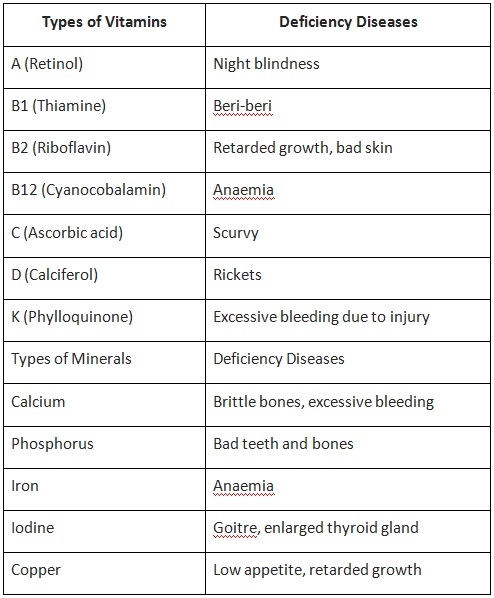
3. Prepare a chart to show various vitamins and minerals and the disorders caused by their deficiency.
Answer Key-
Multiple Choice Answers:
1. deficiency
Explanation:Diseases that occur due to lack of nutrients over a long period are called deficiency diseases.
2. both (a) and (b)
Explanation:Repeated washing of rice and pulses may remove vitamins and minerals present in them.
3. Nutrients
Explanation:Nutrients get lost in the process of cooking and preparations.
4. Many useful proteins and considerable amount of minerals are lost
Explanation:Many useful proteins and considerable amount of minerals are lost if excess water is used.
5. All of these
Explanation: Through all of these given statements we get most of water, that our body needs.
6. 3
Explanation:A child takes 3 meals everyday.
7. Curd, Roti, Dal
Explanation:We eat curd, roti, dal in our breakfast.
8. 7
Explanation:7 groups can be classified as nutrients required by our body.
9. Carbohydrates
Explanation:Carbohydrates are made up of carbon, hydrogen and oxygen.
10. Fats
Explanation:The excess carbohydrates are mainly stored in the body as fats.
11. both (a) and (b)
Explanation:Carbohydrates are present in the form of sugar and starch.
12. 20
Explanation:The human body is made up of 20 amino acids.
13. Proteins
Explanation:Proteins are body building foods.
14. both have oxygen, carbon and hydrogen
Explanation:Both have oxygen, carbon and hydrogen.
15. the amount of oxygen is less in fats as compared to carbohydrates
Explanation:The amount of oxygen is less in fats as compared to carbohydrates.
Very Short Answer:
1. Answer:No, all meals do not have the same food items.
2. Answer:A meal should have different food items because our body needs different kinds
of nutrients for proper functioning.
3. Answer:No, all foods do not contain sill the nutrients required by our body.
4. Answer:(i) Starch (ii) Sugar
5. Answer:The compounds of carbon, hydrogen and oxygen which provide energy for our
body are called carbohydrates.
6. Answer:The colour of the substance becomes blue-black.
7. Answer:Starch.
8. Answer:(i) Potato(ii) Rice/wheat/maize/sugar
9. Answer: An oily patch on paper shows the presence of fat.
10. Answer:(i) Carbohydrates (ii) Fats
Short Answer:
1. Answer: The components of food which are needed by our body for growth and development
are called nutrients.
The major nutrients are:
(i) Carbohydrates (ii) Fats (iii) Proteins (iv) Vitamins (v) Minerals
2. Answer: They complete the energy requirements of the body so they are called energy providing food.
3. Answer: Take a piece of the food item. Put 2-3 drops of dilute iodine solution on it. If the colour of the
food item becomes blue-black, then it indicates the presence of starch in the food item.
(i) Food + Iodine - Blue-black colour (starch present)
(ii) Food + Iodine - No blue-black colour (no starch present)
4. Answer: Proteins are the most important nutrient. They are called body-building food. They help in
the growth and repair of damaged cells and tissues of the body. They also help our body to fight
against infections. Proteins make our nails, hair and muscles.
5. Answer: Take a small quantity of the food item. If the sample is solid, grind it. Put some part of this in
a clean test tube, add 10 drops of water to it and shake the test tube. Now, with the help of a dropper,
add two drops of solution of copper sulphate and 10 drops of solution of caustic soda to the test tube.
Shake well and place the test tube in test tube stand for a few minutes.
Observe colour of the contents of test tube. If colour of the contents turns violet, the food item contains protein.
Note: Copper sulphate and caustic soda solutions are harmful. Handle them with care.
Food + water + copper sulphate + caustic soda → violet colour → protein is present.
6. Answer: The energy rich sources of food are called fats. They provide energy to the body. All types of nuts,
mustard seeds, milk and butter are the major sources of fat. Like carbohydrates, fats also contain carbon,
hydrogen and oxygen but fats contain less oxygen than carbohydrates.
7. Answer: Take small quantity of the food item. Rub it on a piece of white paper. Observe carefully, you will
find that the piece of white paper shows an oily patch on it which indicates that the food item contains fat.
8. Answer: They are protective compounds with no energy value. They help in proper body- functioning and
are required by the body in very small quantities. Various kinds of vitamins are - Vitamin A, Vitamin B-complex,
Vitamin C, Vitamin D, Vitamin E and Vitamin K.
Long Answer:
1. Answer: The various types of nutrients are:
(i) Carbohydrates: They are mainly energy-providing nutrients.
(ii) Fats: They provide energy for the body. They give much more energy than carbohydrates if
consumed in same amount.
(iii) Proteins: They are called body-building foods. Proteins help in the formation and repairing of body parts.
Skin, hair, muscles, enzymes are made up of proteins.
(iv) Vitamins: Vitamins help in protecting our body against disease. They also protect eyes, bones, teeth and gums.
(v) Minerals: Minerals are essential for proper growth of body and to maintain good health.
2. Answer: A diet which provides the right proportion of all the nutrients that our body needs along with roughage
and water is called balanced diet. The various components of balanced diet are carbohydrates, fats, proteins,
vitamins, minerals, roughage and water.
3. Answer: